For you alone
A Place at the Table
a quiet practice for the people you carry
Begin here
A personal recording from me
Lay your table out in front of you, find a spot where you won't be interrupted, and press play. I'll walk you through it.
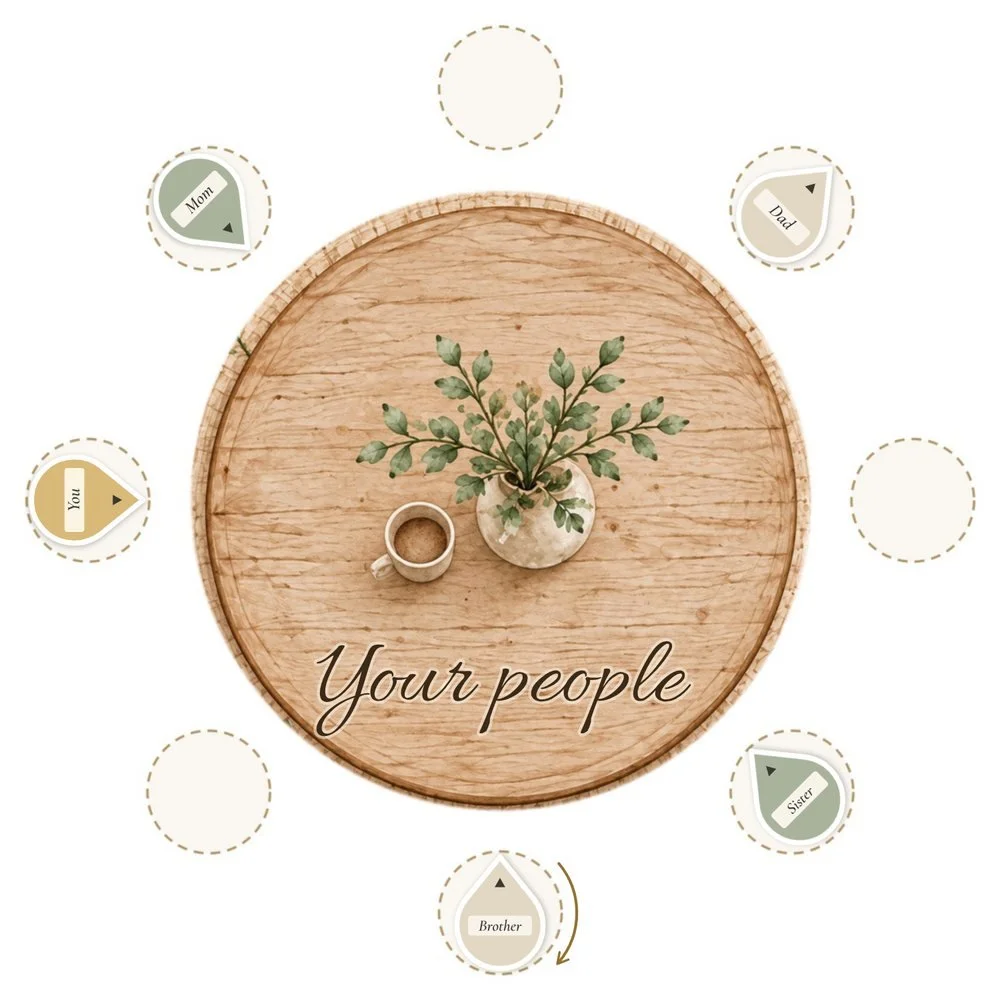
The point on each piece shows which way that person is facing.
Setting the table
Write your name on one piece and set yourself down first, wherever feels like yours. Choose one person. Write their name on a piece and place them wherever your body says they belong. Move them closer, beside you, in front of you and further away. Turn them to face a new way. Notice where your breath eases and where it tightens. Stay with one question from the edge of your table, or turn over a card below. When you've spent time with a few people, set everyone down together and look at the shape you grew up inside.
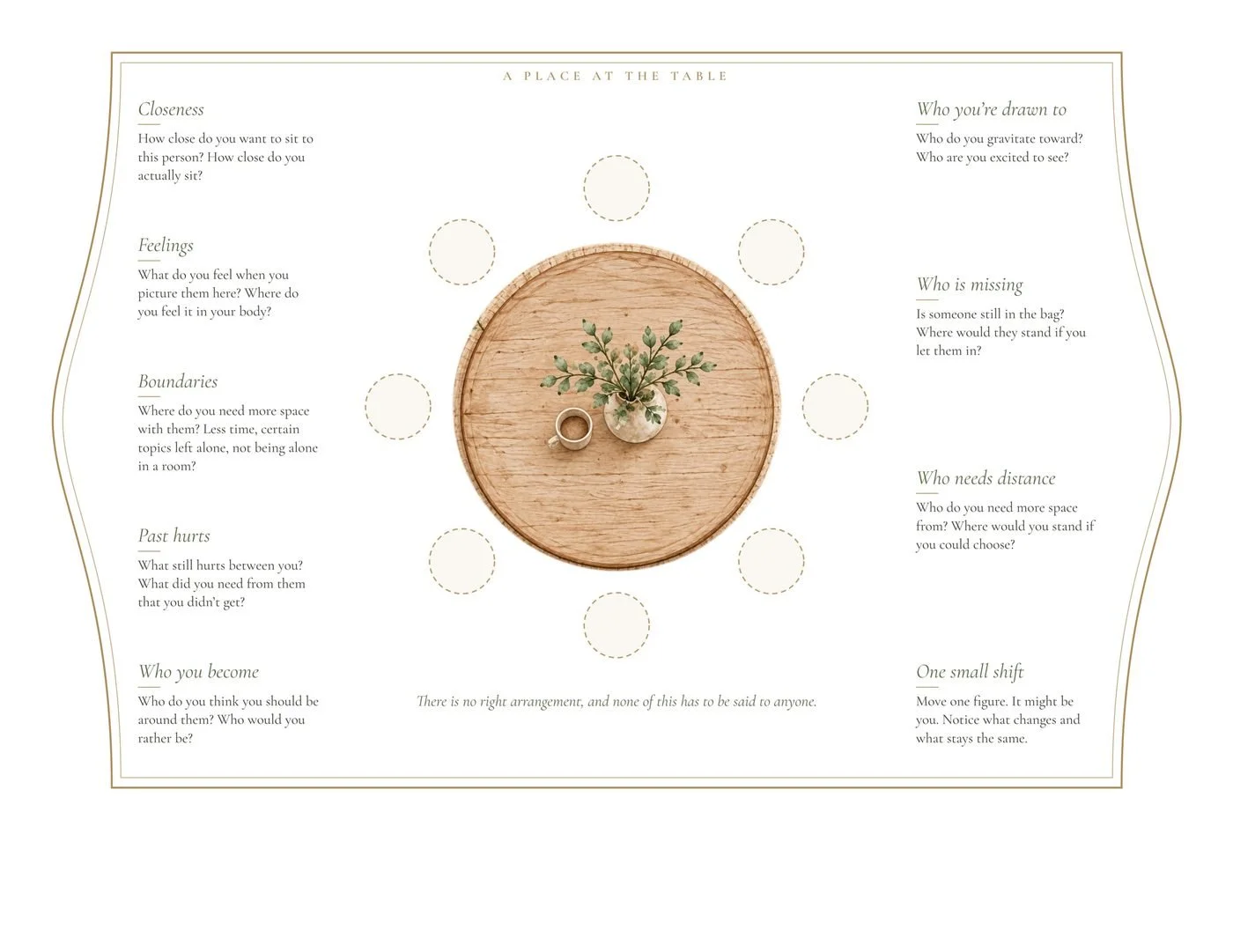
The questions On the table These are the nine questions printed around your table. Tap a card to see why we ask it.
On the table Closeness How close do you want to sit to this person? How close do you actually sit? Tap to turn over Closeness Why we do this There is often a gap between the closeness you long for and the closeness you live. Naming both lets you see that gap without judging it.What to feel for A tug toward them, or a quiet lean away. Notice which one is stronger.What it can show you The distance that feels honest right now. It can change over time.
On the table Feelings What do you feel when you picture them here? Where do you feel it in your body? Tap to turn over Feelings Why we do this Feelings show up in the body before they have words. Finding where they live gives you something steady to stay with.What to feel for Warmth, tightness, heaviness or a flutter in your throat, chest, belly or hands.What it can show you What this relationship asks of your body, and what it gives back.
On the table Boundaries Where do you need more space with them? Less time, certain topics left alone, not being alone in a room? Tap to turn over Boundaries Why we do this Boundaries can be small and specific. Knowing exactly where you need space lets you protect it without pulling away from the whole relationship.What to feel for Relief at one idea and resistance at another. Your body often knows which limit fits.What it can show you One clear, kind limit you can keep for yourself. You never have to announce it.
On the table Past hurts What still hurts between you? What did you need from them that you didn’t get? Tap to turn over Past hurts Why we do this Old hurt often holds a relationship at a certain distance. Naming the need underneath it lets you begin to tend it yourself.What to feel for A softening, an ache, or the urge to explain it away. Let it be there for a breath or two.What it can show you The need that is still waiting, and other ways it might be met now.
On the table Who you become Who do you think you should be around them? Who would you rather be? Tap to turn over Who you become Why we do this Many of us slip into an older role with certain people. Seeing the role clearly gives you a choice.What to feel for Changes in your posture, your voice and how much room you take up.What it can show you The version of you that feels true, and one small way to bring her into the room.
On the table Who you’re drawn to Who do you gravitate toward? Who are you excited to see? Tap to turn over Who you’re drawn to Why we do this Every family has places where it feels easy to be. Knowing where you are fed helps you lean there more often.What to feel for Lightness, a smile, an easy breath as you set them down.What it can show you The relationships that support you.
On the table Who is missing Is someone still in the envelope? Where would they stand if you let them in? Tap to turn over Who is missing Why we do this Someone left out of a family still shapes it. Giving them a place lets the whole picture settle.What to feel for Hesitation before you place them, and what shifts once they are down.What it can show you Who the family has been quietly working around.
On the table Who needs distance Who do you need more space from? Where would you stand if you could choose? Tap to turn over Who needs distance Why we do this Choosing your own place in the system is a form of self-respect. Distance can be loving.What to feel for Your breath as you move yourself, and whether guilt or relief arrives first.What it can show you Where you belong in your family on your own terms.
On the table One small shift Move one figure. It might be you. Notice what changes and what stays the same. Tap to turn over One small shift Why we do this Small changes on the table help the picture inside you loosen. You don’t have to fix the whole family.What to feel for Any difference in your body before and after, even a subtle one.What it can show you That the shape you grew up inside can move.
When you're ready Going deeper Five more cards for once you've sat with the table a few times. Take them in order, one at a time.
Going deeper I · See where you stand Move them closer to you, then beside you, in front of you, and further away. Where does your body settle? Tap to turn over I · See where you stand Why we do this Your mind has an idea of where this person belongs. Trying each place lets your body show you the distance that actually feels right with them now.What to feel for Where your breath eases or tightens. The spot that brings relief.What it can show you How much closeness feels good with this person, which can guide your time and your boundaries with them.
Going deeper II · Name the job What do you do when you’re near this person? Tap to turn over II · Name the job Why we do this Children learn to do something that keeps them close and keeps the family steady. You may still be doing it without noticing.What to feel for The urge to fix, smooth, cheer, shrink or watch. Notice what your hands want to do.What it can show you The job you were given, still running today.
Going deeper III · Hand it back What are you carrying that was never yours? Tap to turn over III · Hand it back Why we do this In families, feelings one person can’t hold often pass to someone else, usually a child.What to feel for A heaviness that seems older than you, or bigger than your own story.What it can show you Which weight belongs to you and which you picked up out of love.
Going deeper IV · Take your place Come back to your own place. No bigger and no smaller. Tap to turn over IV · Take your place Why we do this When you carry others, you either grow to hold everything or shrink to stay out of the way. Your place is the size of you.What to feel for Your feet, your spine and the space around your body.What it can show you What it feels like to belong without performing.
Going deeper V · Feel it move Move one figure a hand’s width. What changes in you? Tap to turn over V · Feel it move Why we do this A small change in where a figure stands often creates a real change in how you feel.What to feel for The difference between before and after, even a subtle one.What it can show you That the picture you carry inside can move.
Printables
Print another table
If yours gets worn, or you'd like a second one to keep somewhere else, you can print it on letter paper, turned sideways.
This isn't therapy, and there's nothing to fix or figure out. Nothing you notice needs to be said to anyone. If something heavy comes up, you can stop, put the pieces back in their envelope and come back another day.